The mystery of Pearl Street: Nobody knows how Boulder’s most famous street got its name
As Boulder gears up for next year’s 50th anniversary celebration of the Pearl Street Pedestrian Mall, now is a good time to reflect on Pearl Street’s past. In a series of articles to be spread throughout the year, we’ll go back in time and view the thoroughfare that still defines the heart of downtown Boulder.
Read more Meet the candidates for Boulder County treasurer in the 2026 Democratic primary
A small group of gold prospectors arrived in what would become Boulder in October 1858. The gold-seekers set up cabins and tents along Boulder Creek, then their settlement grew into a supply town for miners in the mountains. In February 1859, one of the men, A. A. Brookfield, wrote a letter to his wife Emma, back home in eastern Nebraska. He stated, “We thought that as the weather would not permit us to mine, we would lay out and commence to build what may be an important town.”
That same month, 58 prospectors (including Brookfield) signed the “Articles of Organization of the Boulder City Town Company,” requesting a charter from the governor of Nebraska Territory. (At the time, Nebraska Territory extended west through the Boulder area and encompassed land north of the 40th parallel, now Baseline Road.)
The early settlers were not surveyors. One of the charter signers simply drove a stick into the center of today’s intersection of 12th (now Broadway) and Pearl streets. Then, to determine a straight line for Pearl Street, he sighted across the stick to Valmont Butte to the east. The rest of the streets in the “original town” were laid out in a southwest-to-northeast orientation, parallel to and perpendicular to Pearl Street.
No one in modern times seems to know why Boulder’s first settlers chose the name “Pearl.” Several theories have been proposed, including that the street was named for early Boulder resident Hannah Pearl England, but she had no connection with Boulder until the 1870s. A more likely speculation (without an explanation) was suggested in 1944 by a longtime Boulder resident who wrote in a letter to a newspaper editor, “The name of Pearl Street was given in honor of the wife of one of the organizers of the town.” Perhaps so, but which one? No one knows.
In December 1859, ten months after Boulder’s founding, the town’s population had grown to 200 men and 17 women. Only one cabin had a wooden floor, which was put to good use for the frontier town’s first Christmas dance.
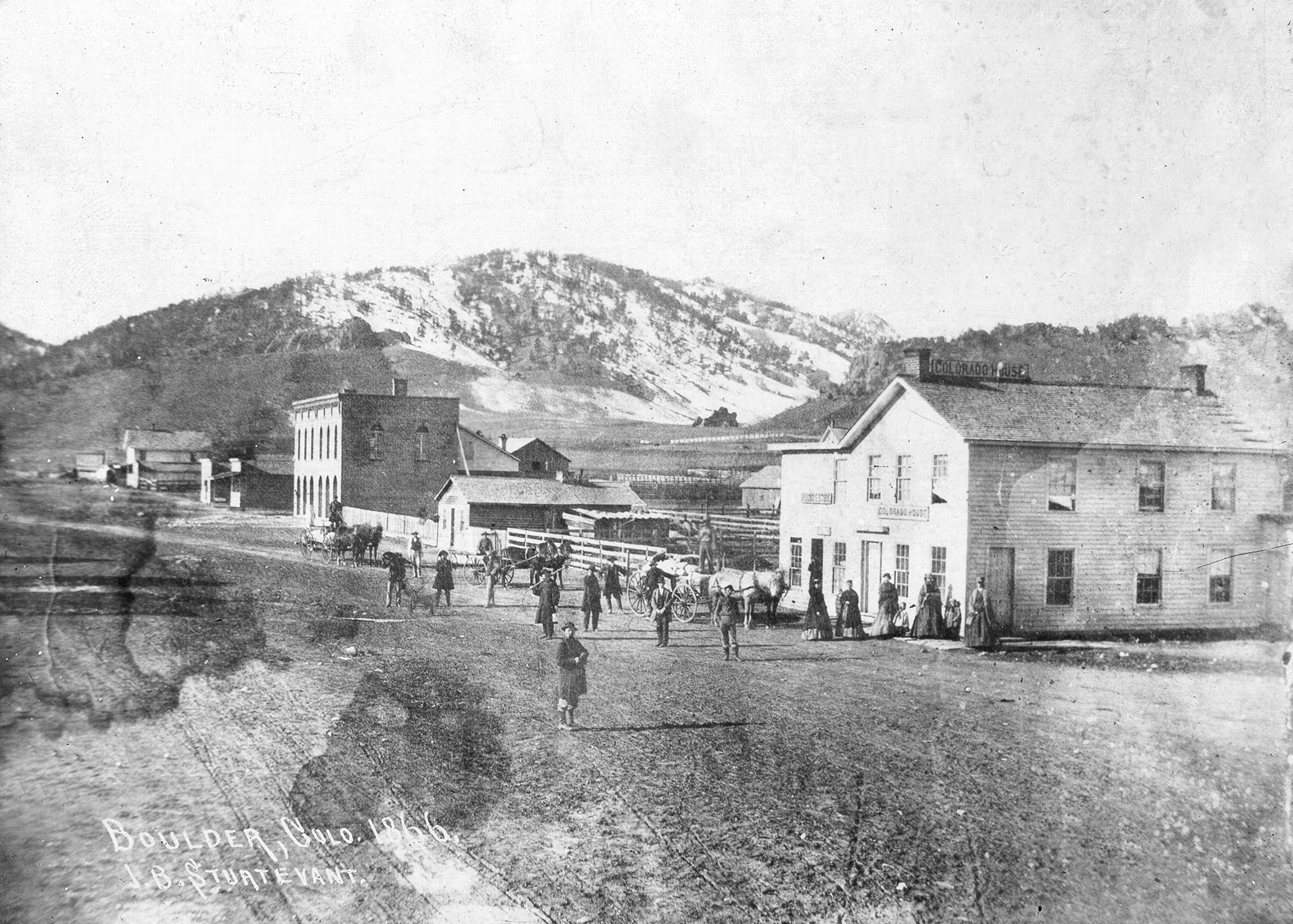
Between 1860 and 1880, Boulder grew from 300 to 3,000 people. Its wooden sidewalks and dirt streets looked like those in films of the old West. Unlike the Hollywood versions, however, there was little crime and no reported gunfights. Drunks, though, were a common sight.
At the time, little was done to improve the streets. Early Boulder resident William Burger once wrote, “After rains or melting snows, Pearl Street was deep in mud. In summer it was deep with dust, and the streets were thick with droppings from horses and mules, and millions upon millions of flies abounded everywhere.”
Architecture left something to be desired, as well. Likely, the town’s residents smarted from Englishwoman Isabella Bird’s comment on a then-recent visit to Boulder when she wrote that the town was “a hideous collection of frame houses on the burning plain.” The only trees in the early days were boxelders and willows that grew wild along the creeks.
Read more Boulder bet $34 million to land Sundance. High lodging prices are raising concerns.
Colorado was granted statehood in 1876. Six years later, on the Fourth of July in 1882, a local newspaper reporter commented on the holiday. “It was ushered in by all manner of shooting and noises,” he wrote, “the youth of the city having ample opportunity to vent their fiery patriotism and to spend their money to an extravagant extent.”
That same day, crowds witnessed the laying of the cornerstone for the Victorian-era Boulder County Courthouse. (Following a fire in 1932, the building was torn down and replaced with today’s Art Deco-style courthouse.)
By the 1880s, additional buildings of brick and stone had begun to replace downtown Boulder’s rough wooden structures, bringing a look of permanency to Pearl Street.
Along with dry goods and other merchandise, trees were shipped in by train. Downtown, the whole city block known as “courthouse square” was lined with maple saplings. As they matured, they provided beauty and shade for shoppers and visitors. Horses pulling wagons and carriages eagerly drank from city-provided water troughs.
At night, downtown visitors carried lanterns or hung them on their carriages. By 1888, the city had provided three carbon arc lamps that ran on electricity generated by a small power plant located on the northwest corner of Spruce and 13th Street, now the location of the Hotel Boulderado.
By the end of the 19th century, Pearl Street had become a busy mix of pedestrians and horse-drawn vehicles. Open irrigation ditches ran along both sides of the still-dirt street, but permanent buildings of brick and stone had replaced the older wooden structures. Boulder had grown from a dusty frontier town into a still dusty, but established, small city.
As for the Brookfields, A. A. spent his last days in the Colorado State Hospital (then referred to as “the insane asylum”) in Pueblo. Hopefully, he’s resting peacefully today, next to Emma in Boulder’s Green Mountain Cemetery.
Read more 📬 Ballots are here. Meet the candidates.
Perhaps one of the other 57 founders had a wife named Pearl.
