Colorado appeals court sides with Boulder in camping ban challenge
The Colorado Court of Appeals upheld the City of Boulder’s camping ban ordinance, rejecting arguments that the law violated the constitutional rights of unhoused residents who cannot access indoor shelter.
Read more Boulder County advances wildlife crossing plans on U.S. 36 as Colorado nears new funding source
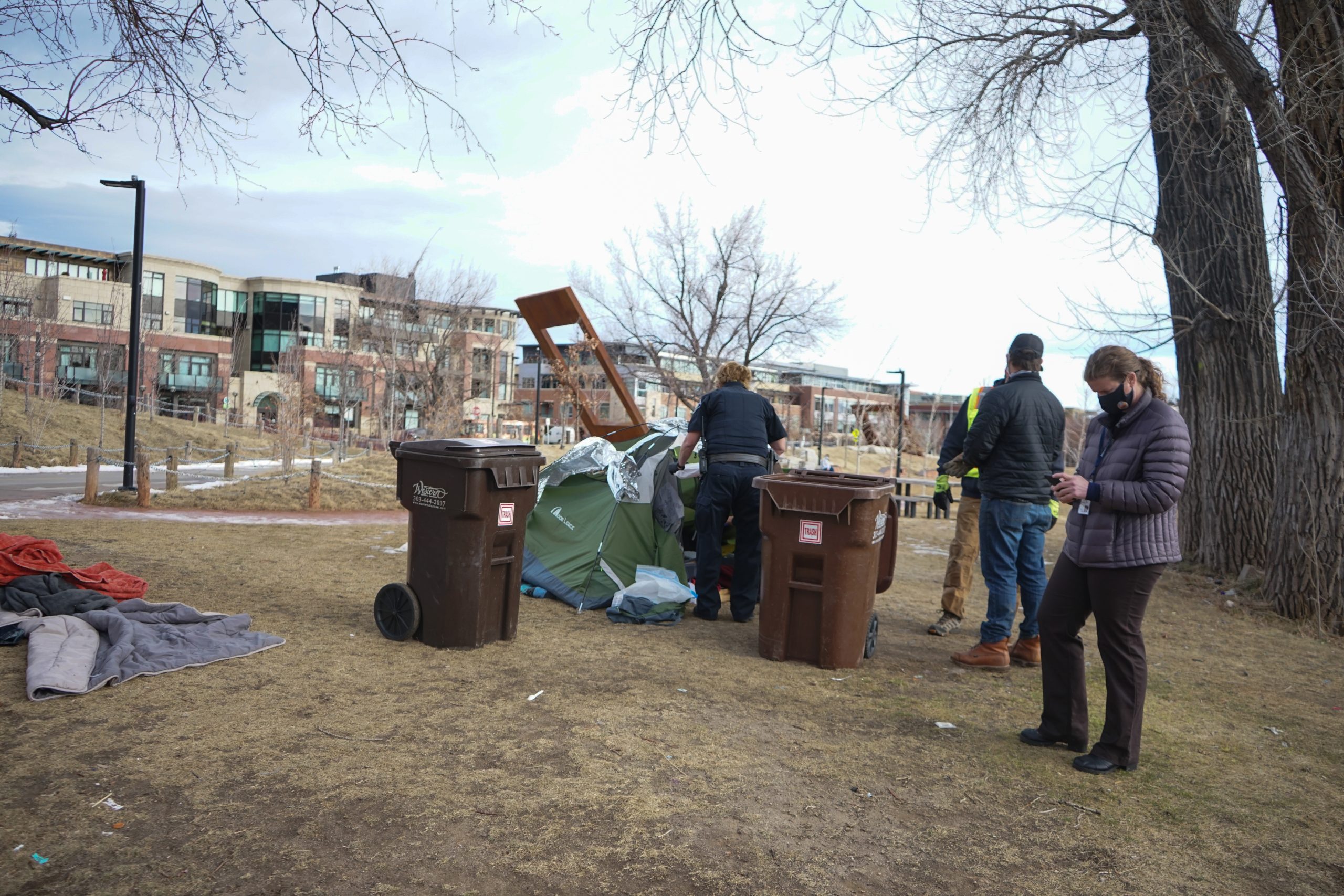
The ruling is a blow to a lengthy effort by civil rights advocates to halt enforcement of the ordinance, first adopted in 1980, which allows police officers to ticket homeless people for sleeping in public spaces with “any cover or protection from the elements other than clothing.”
In 2022, the ACLU of Colorado sued the city on behalf of Feet Forward, a now-dissolved homelessness services organization, and several homeless residents, arguing the camping ban ordinance violated the Colorado Constitution’s protections against cruel and unusual punishment, freedom of movement and use of public spaces, and due process protections against “state-created danger.”
The three-judge panel, in a May 14 opinion authored by Judge Eric Kuhn with Judges Terry Fox and Grant T. Sullivan concurring, found no constitutional violation on any of the three grounds. In several instances, the opinion acknowledged the challenging circumstances of several plaintiffs before ruling against them.
“Boulder’s residents without a safe place to rest indoors understandably may seek to shelter on public property,” Judge Kuhn wrote. “But no matter how sympathetic their plight, these circumstances alone don’t create new state constitutional rights.”
The decision is the latest and perhaps most significant setback for the case, following the U.S. Supreme Court’s 2024 ruling in City of Grants Pass v. Johnson upholding the constitutionality of a similar ordinance. Boulder County District Court initially allowed the case to proceed before dismissing it under the Grants Pass precedent. The plaintiffs appealed to the Court of Appeals. They could appeal to the Colorado Supreme Court and said they are considering their legal options.
The plaintiffs’ core argument following the Grants Pass decision was that Colorado’s constitutional protection against cruel and unusual punishment is broader than its federal counterpart, the Eighth Amendment. The judges said they were not persuaded.
In Grants Pass, the Supreme Court ruled that a similar Oregon ordinance did not constitute cruel and unusual punishment because it targeted conduct, such as sleeping outside, and not the status of homelessness.
The plaintiffs in the Boulder case argued the line between conduct and status is sometimes “inseparable” when the conduct is necessary for survival.
Several plaintiffs were homeless people who were unable to access the city’s main shelter, All Roads, in North Boulder. According to the complaint, one plaintiff had four dogs, which are not allowed at the shelter. Another worked at a local restaurant and could not return to the shelter during its intake window. Additionally, a 2022 Boulder Reporting Lab analysis of police records also found people were ticketed for camping on days when All Roads, then called the Boulder Shelter for the Homeless, turned people away because it was full.
The court acknowledged the tension, stating that “reasonable minds can disagree” on the distinction between status and conduct. But the judges concluded that homelessness is not involuntary in all instances, citing “a complex web of factors and individual circumstances” that contribute to it, including “preferences, comfort level, work schedules, relationship status, and having animal companions.”
Read more 🥪 A new reason to eat in East Boulder: East & Co.
“We appreciate the tension in differentiating between a person’s conduct and status when their conduct involves basic activities for survival due to an involuntary status,” Judge Kuhn wrote. “That said, there is no precedent establishing that a person should be treated under our constitution as if they have a medical condition — effectively ‘an illness or infirmity’ — based on their inability to access or afford indoor shelter.”
Plaintiffs also argued that the right to freedom of movement under Colorado’s constitution includes a right for people with no access to indoor shelter to sleep on public property. The court disagreed.
The court found that Boulder demonstrated a legitimate public health reason for enforcing the camping ban. In previous court filings, the city said the ordinance helps prevent “tent cities,” which it argued deprive others of the ability to use public lands and raise the potential for public health problems related to “entire communities disconnected from the city’s water and sewer systems and without trash collection service.”
“A resident occupying public property to shelter for sleep and rest necessarily interferes with every other resident’s ability to traverse, use, and enjoy that same space,” Judge Kuhn wrote.
Lastly, the plaintiffs alleged that by prohibiting unhoused people from sheltering outdoors, Boulder’s ordinances exposed them to harm from the elements. The court rejected this “state-created danger” argument, stating that it requires harm inflicted by a third-party person, not by the environment.
Tim Macdonald, legal director of the ACLU of Colorado, said in a statement that the organization was disappointed.
“This is a devastating, though hopefully only temporary, blow to the promise of the Colorado Constitution, to the rights of our unhoused neighbors, and to the lives and safety of everyone at risk of homelessness — which can happen to anyone,” he said.
Macdonald said Boulder is one of the most expensive cities in Colorado.
“Instead of directly addressing this glaring crisis of unaffordability, some local governments want to double down on punitive measures meant to merely sweep poverty from public view,” he said. “This state-sponsored attack on survival continues to be unconscionable.”
The City of Boulder said in a statement that it appreciates the decision.
“Homelessness remains a serious and complex issue, and the city will continue working with service providers and regional partners to connect people with shelter, housing pathways and support,” the statement read. “Boulder’s approach will continue to balance compassion for individuals experiencing homelessness with accountability for maintaining shared public spaces.”
Read more Boulder Market Meals: Meet the green alliums brightening spring cooking

Related Posts
Boulder offers $1.3 million loan to help San Lazaro residents buy their mobile home park. They still need $30 million.
Boulder County commits $11 million to help San Lazaro residents buy their mobile home park