Boulder County farmers scale back crops, CSAs and staffing as drought reshapes the growing season
After one of Colorado’s driest winters on record, Boulder County farmers spent months preparing for what many feared would be a devastating growing season. Recent rains have brought some relief, but much of the region remains in severe drought, and many local growers say the moisture came too late to fundamentally change their plans for the summer.
Read more 🏠 Can Jamestown save its beloved Mercantile Cafe?
Across Boulder County, farms are shrinking CSA programs, cutting staff, reducing acreage and shifting toward crops that require less water. Farmers say shoppers will still find local produce at markets this summer, but less of it — and with fewer of the water-intensive staples that usually define the height of the growing season.
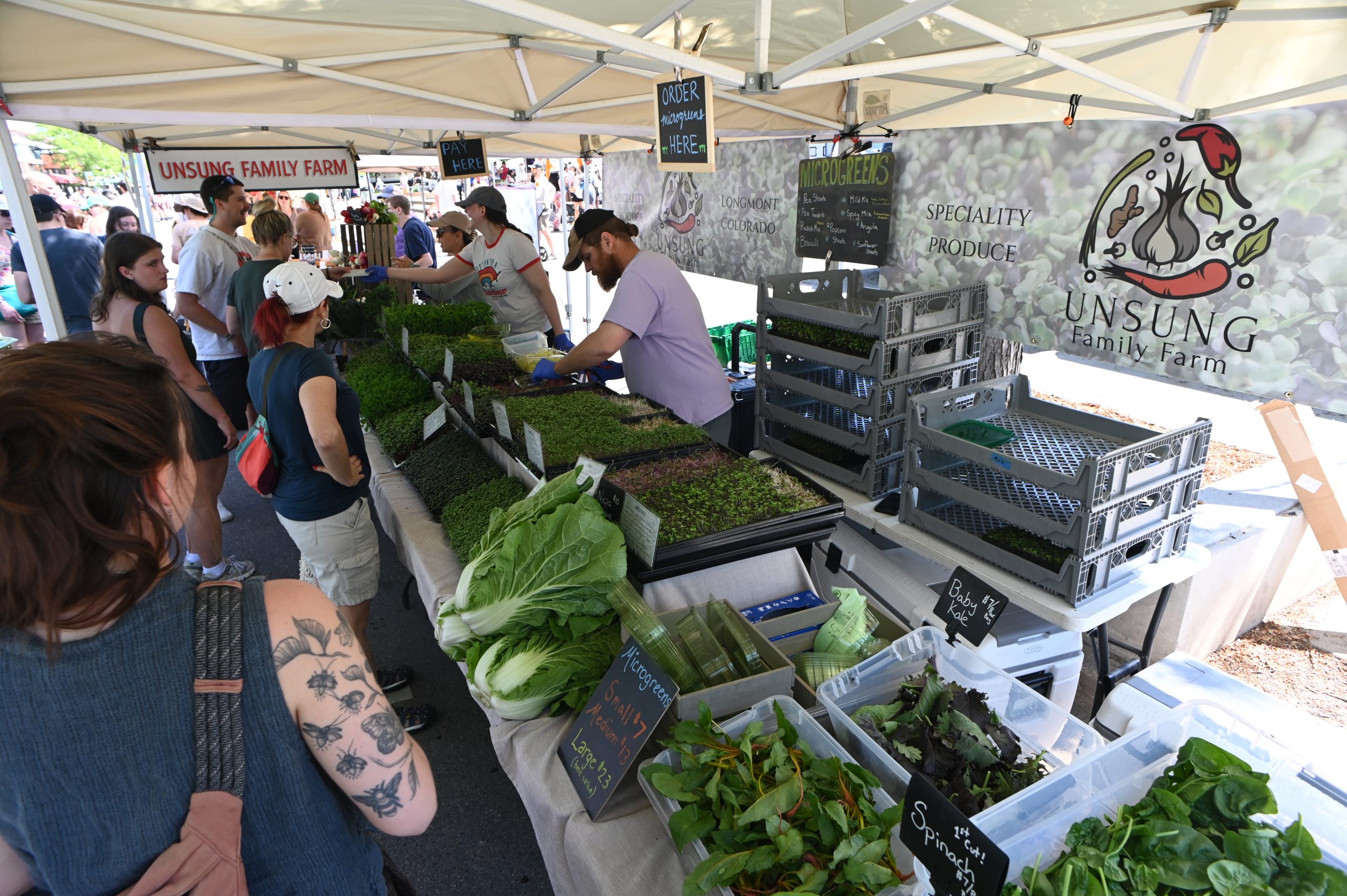
At the Boulder County Farmers Markets, Executive Director Mackenzie Sehlke said shoppers may notice a different kind of abundance this year.
“We say, ‘Stack ’em high and watch ’em fly’ in the farmers market industry — those big, bountiful fruit and vegetable displays,” she said. “It might look a little bit leaner this year, but we will know that what is there is gonna be even more precious.”
At Black Cat Farm, chef and owner Eric Skokan said the operation began triaging crops months ago.
“I had a series of scenarios based on what the weather would look like, best case to worst case, and each month I would revise it,” he said. “The best-case scenarios became worse and worse and worse.”
“It’s going to look bleak,” he said. “It’s so bad that it’s made it really easy, mentally, to scale back the operation.”
Black Cat farms 500 acres, including about 100 acres of food crops. This year, Skokan said, the farm scaled back row crops to just a few acres while focusing on crops that can survive on far less water.
Though Black Cat has relatively strong senior water rights, Skokan said the issue is not legal access to water but the lack of water itself.
“There just isn’t any water,” Skokan said. “It’s not that divvying up the pie is the unfair part of it. It’s that the pie is minuscule this year.”
Water that would normally last through October will likely run out by June or July, he said, leaving later-season crops especially vulnerable.
As a result, there will likely still be spring vegetables — peas, asparagus and fast-ripening radishes — but less zucchini, corn and winter squash. Fields that would normally grow baby fennel, spinach and other produce are instead being planted with garbanzo beans and lentils.
Because of the drought, he’s also using drip tape, which he usually avoids because it’s nonrecyclable plastic, to water fields more efficiently. Workers are using propane torches to burn weeds above ground rather than tilling them under, which releases soil moisture into the air.
Black Cat has canceled the farm’s CSA program this year, closed the farm store and scaled back its footprint at the Boulder and Longmont Saturday farmers markets from 40-foot booths to 10-foot booths.
The farm was fortunate, Skokan said, that last year’s wheat harvest was “spectacular” and that it produced a bumper crop of tomatoes.
“At the farmers market, we’re serving lots of focaccia with tomato,” he said. “But we’re really fortunate relative to some of the other farms in that we’ve been diversified for a long time in terms of income streams and the crop mix that we have.”
Read more Boulder Market Meals: Bok choy and local mushrooms star in a savory summer stir-fry
The farm’s restaurant and on-farm dinners have become the priority because they employ the most people, Skokan said.
“That’s the part that makes me have knots in my stomach, is not having water to grow vegetables and having to reduce the staff that we have at the farm,” he said. “These are families who’ve counted on us for years, and unfortunately all of this is very much out of our control.”
At Switch Gears Farm in Longmont, Vanita Patel said she and her farming partner, Brett Matson, had hoped to grow 2.5 acres of produce this year, plus another acre or acre-and-a-half of cover crops.
Now, she expects the farm will grow about an acre of produce through July and then a quarter-acre to finish out the season.
The farm relies on junior water rights and lacks a large enough pond to store ditch water.
In a typical year, Patel said, the farm would expect four opportunities to flood-irrigate fields. This year, she expects just one and plans to purchase water from another shareholder to secure a second.
“Every farmer is going to be forced to make a lot of adjustments,” Patel said.
Switch Gears has reduced its CSA offerings from 70 shares to 40 and scaled back hiring plans from several workers to potentially none.
Patel said crop plans now shift constantly depending on rainfall forecasts and water availability. The farm expects to grow more greens and lettuces and fewer water-intensive crops such as tomatoes, peppers and eggplant.
“We’re going to have limited amounts of those highly seasonal things,” she said. “Sweet potatoes and potatoes are one of those things where we’re trying to see if there’s anything we can do to put them back in the rotation.”
Patel and others said this is also a good year for people to try growing some food at home, even if it’s just a small bed of carrots, herbs or perennials.
“Brett and I, this whole winter, have been talking about victory gardens,” she said. “Support farmers when we can, grow some of the stuff that we know we need for staples, so if our supply chain gets disrupted, you still have some basics covered in your home or community.”
Beyond the financial impact, Skokan said community support matters emotionally for farmers enduring a difficult season.
“Having the community participate and purchase what they are able to, it doesn’t necessarily solve all of the financial problems that come in a catastrophic year like this,” he said. “But on a personal level, or a community level, it is absolutely felt by the farmers to know that they’re loved and cared for and valued.”
Peter Wanburg of the Lafayette Colorado Farmers Market said this is a year for residents to think of local food markets as relationships, not just transactions.
“You’re building something that can allow farmers to withstand these ebbs and flows,” Wanburg said. “Relationships can weather storms, whereas impersonal transactions cannot.”
Read more Federal judge blocks Trump administration’s first move to break up Boulder-based NCAR