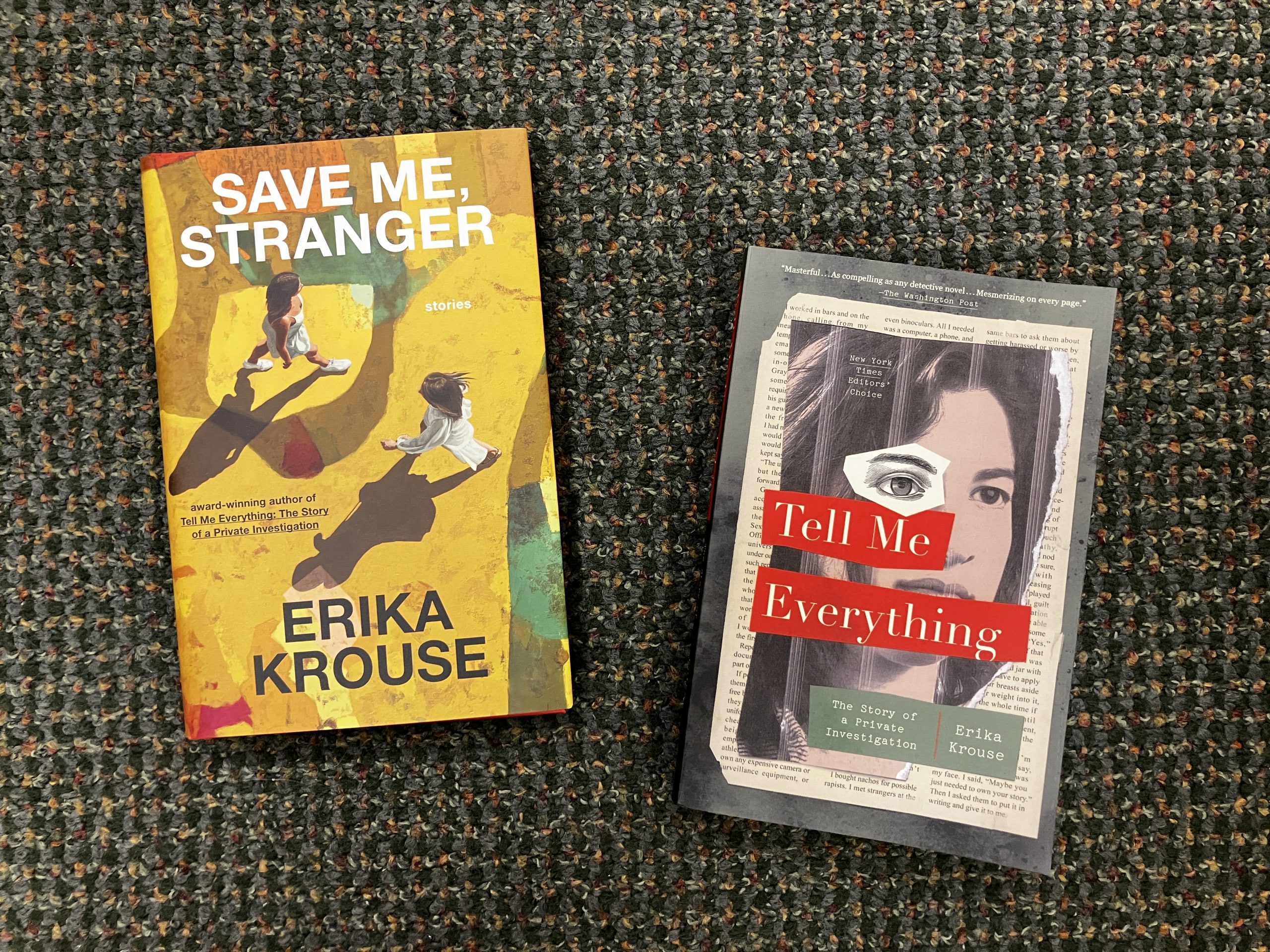
Boulder author Erika Krouse on the stories that won her a $50,000 national prize
Boulder author Erika Krouse has won the 2026 Joyce Carol Oates Prize for “Save Me, Stranger,” her 2025 collection of short stories.
Read more 📝 Five commissioners? Boulder County measure likely headed to ballot
The New Literary Project announced the award May 5. The prize, which comes with $50,000, honors a mid-career fiction writer “of national consequence.”
Krouse is an acclaimed teacher and the author of four books of fiction and nonfiction. Her previous works include “Tell Me Everything: The Story of a Private Investigation,” a memoir about her role investigating a sexual assault case involving a prominent university. The book is set in Boulder.
Boulder Reporting Lab spoke with Krouse about the collection, the meaning of literary recognition, Colorado’s writing community and how living on the Front Range has shaped her work. This interview has been edited for clarity and brevity.
First things first, huge congratulations on winning the Joyce Carol Oates Prize! How did it come about?
I was astonished. It’s very rare to get any kind of prize. I am still thrilled and baffled.
You’re nominated by your publisher. Once all the nominations are in, these hardworking jurors read scores and scores of books and create a very nice longlist. When the longlist is published, you’ve already won something. From the longlist, they curate five finalists, and then the judges — the board and Joyce Carol Oates — pick the winner. I can still barely believe it, but I’ll take it.
The award recognizes both “Save Me, Stranger” and your larger body of work. What does that mean to you at this point in your career?
It’s simultaneously a book prize and also a career prize, because it’s for people who have been writing for a long time, have been publishing and chugging along. It’s very motivating.
I’ve been writing and publishing for many decades. I think of the publishing journey like going up the steps in Chichen Itza: None of the steps are deep enough for you to solidly put your foot down, and there are no handrails, so you don’t ever know where you are. After a while you get really dizzy. You don’t know what the end is, or if there’s an end, if you’re going to fall all the way to the bottom, or if you’re ever going to get to whatever the top is. [Laughs.]
Maybe that’s why this prize is so important, because you do get a lot of vertigo in that middle space, once you’ve been working for a long time and you don’t know where you are.
What questions were you exploring in “Save Me, Stranger?”
The overall themes are about rescue. I didn’t take the “save me” part in a religious way; it’s more like, what does it mean to save someone or to be saved? What do we owe each other as a species? How do we interact with each other when we need help, or when someone else needs help? How do our lives intersect?
I have a lot of questions about these ideas. I wrote one story trying to address them, and after I wrote it, I thought, well, that didn’t answer my questions. So I wrote another, and then I had more questions. So I wrote another and another and another … And at the end of the book, I have 12 stories about this idea, and I don’t really have any concrete answer. But I understand the question a lot better than when I started.
Why was the short-story form right for exploring those questions?
Short stories are by nature a more experimental form. You can play with the shape a little bit more. Short stories did have a renaissance in the 1990s and the 2000s, and since then, all the publishers say the short story is dead, no one is writing short stories anymore. Well, I don’t agree. And neither do literary magazines.
Editor’s note: Erika Krouse is well known in certain literary circles for her “Ranking of ~500-ish Literary Magazines,” a resource that she has made freely available to writers on her website.
The stories unfold in places ranging from Omaha and Tokyo to one of the coldest towns in the world. How do you approach writing about place?
I never think I’m very good at writing setting. [But] with “Tell Me Everything,” the setting was so intrinsic to the story. I was writing about this major Title IX lawsuit which took place in Boulder and at a certain university that we all know but won’t name. It was very easy to write about the place because I had so much familiarity with it.
“Save Me, Stranger” has all these different places: the coldest town in the world (which I’ve never been to), and then a lot of places I have either lived in or been to — Omaha, Nebraska; Tokyo; I’ve visited Thailand. So I had a little bit of familiarity, and I could also do enough research to get in there.
Your current project is also grounded in place, but in a different way. What are you working on now?
Read more Reliable Moving Services in Nevada: Your Stress-Free Relocation Starts Here
It’s historical. The story takes place almost 100 years ago in New York City. It’s a different level of place-based research, because you’re also looking at time and discovering silly things like, you want to say wristwatch, but they were called “strap watches.” What kind of doorknobs they had, what kind of elevators people used. That’s been both an incredible migraine and also really fun.
Do you know when readers might see it?
You never know, unless you sell something in advance. You just don’t know what’s going to happen. You can work on something for 10, 20, 30 years, and it doesn’t see publication. It’s always a big risk.
Writers are big gamblers, except we’re gambling with our time. Our lives, really. We’re hoping, not necessarily for a monetary payout, because that’s extremely rare, but more for the opportunity to be part of the conversation.
How do you let go of one book and move on to the next?
If you get too attached to something you already made, then you’re not going to make something new. You’re just going to keep trying to reiterate the same thing. So when I’m on to a new project, I tend to forget what I did before. It starts to feel very separate from me.
“Save Me, Stranger,” my most recent [book], came out about a year and a half ago, though it feels like a million years ago. I’m writing something new now, so I’m already on to the new challenges. That’s something you have to do if you’re going to write books: you have to let them go.
Your memoir, “Tell Me Everything,”continues to generate discussion several years after its publication. Why do you think it has endured?
People still want to talk about it. Usually a book has around two months of [public] life — you give readings, have events. After about two months, everyone moves on — which is good, because there are a lot of books to talk about and celebrate!
But this one seems to have pretty long legs. People want to discuss the ideas in this book: Title IX, sexual assault, sports, celebrity culture. People want to talk about how things have changed or have not changed, especially with the arrival of Coach Prime and the vast amounts of money being thrown into college sports.
What responses to the memoir have stayed with you?
I’d never had people thank me for writing a book before. Some of them had personal experience with sexual assault, especially in that [18-24] age group, which is one of the most prevalent age groups for sexual assault. One person told me, “I never saw my own experience in a book before,” which was very meaningful to me.
Some people really did not like that I wrote this book and they tried to come after me, legally or in terms of my reputation. But I’ve also found unexpected allies, and that’s been really magical.
I think I’ll die younger from the experience of writing a memoir, but I’m still glad. I’ve never regretted a book that I’ve written, no matter what’s happened with it. I’ve always been glad to have done it.
“Tell Me Everything” won the Colorado Book Award for creative nonfiction. What did that local recognition mean to you?
It’s an honor to win something in your community, because you know how good everybody is. They’re your friends, you’ve read their books, you’ve supported their careers. I’m very grateful.
How has Colorado’s literary community shaped your writing life?
People don’t understand what a vibrant literary community is on the Front Range, and how many incredible writers we have here. We have Lighthouse Writers Workshop, University of Colorado Boulder and Colorado State University; there are writing programs all up and down that corridor.
Writers are strongly nurtured by this place. I have this theory that it’s because we can see the mountains and we know there are heights to reach for.
In general, people don’t understand that this is a big literary hub. A lot of times people think of the writing communities as being on the coasts, and then there’s “the middle.” There are plenty of vibrant communities in “the middle”— the Minneapolis-St. Paul area with the Loft, and Iowa City, of course, with the Iowa Writers’ Workshop.
People have figured out that the readers are everywhere. We don’t just want to read New York stories. Colorado has played a big part in that, partly because a lot of people come to Colorado from everywhere else. This is a destination. It’s like there are all these other geographical streams feeding into the Colorado literary scene, making it even more vibrant, diverse, and interesting.
So true. One final, rapid-fire question for you: What are three of your favorite things about Boulder?
Read more Remembering Judy Walker, devoted advocate for children, bridge Life Master and cherished friend
Magpies, the empanadas at Rincon Argentina and the Flatirons, of course.
