BVSD superintendent apologizes for district’s handling of antisemitic harassment, proposes reforms
Boulder Valley School District Superintendent Rob Anderson on Tuesday proposed changes to the district’s bullying and discrimination policies that would explicitly recognize antisemitism, part of a broader response to a federal complaint alleging the district failed to protect a Jewish student from nearly two years of harassment.
“When BVSD fails to respond effectively to issues of hate appropriately and consistently, it creates fear within our community that all students are not safe,” Anderson told the Board of Education. “I apologize to our community for failing to ensure the appropriate systems and procedures were in place to better protect students.”
The complaint was filed June 11 with the U.S. Department of Education’s Office for Civil Rights by the Anti-Defamation League on behalf of a Southern Hills Middle School student. It alleges that school officials failed to stop nearly two years of antisemitic harassment of the student, even after school and district investigations concluded that the student faced a hostile environment.
The 52-page complaint describes spitting, repeated antisemitic slurs, three alleged assaults and a game students allegedly called “Jew touch tag.” According to the complaint, the district investigation confirmed bias-motivated bullying based on the student’s Jewish identity.
The most serious alleged incident occurred in December 2025, about eight months after those investigations. While a teacher was briefly out of the classroom, a student tied a computer charging cable into a lasso, threw it around the Jewish student’s neck and pulled him backward from a chair while using an antisemitic slur, the complaint alleges.
The teacher heard the slur and witnesses later described what happened, but the teacher did not report the incident, accordingtothe complaint. Police later issued a juvenile summons for third-degree assault, according to police data. The accused student was suspended for the remainder of the week, the complaint alleges.
The filing also alleges that the student’s family copied Anderson on urgent emails after two assaults that led to police involvement but received no response from Anderson or other district staff. In one instance, the family asked Southern Hills Principal Melinda Murphy to separate the student from two students involved in documented bullying. Murphy allegedly replied, “We will do our best.”
The Office for Civil Rights did not respond to questions about the status of the complaint. Randy Barber, a spokesperson for BVSD, said the district is involved in pre-investigation mediation with the U.S. Department of Education’s Office for Civil Rights and the ADL.
The board did not vote on the proposals Tuesday.
Proposed policy changes
The proposals come amid a broader debate over how BVSD handles discrimination and bullying complaints.
A law signed by Gov. Jared Polis on June 1 establishes new standards for discrimination complaints. It makes certain failures to address harassment involving a protected class violations of state law.
As part of its requested remedies, the ADL called on the district to incorporate the International Holocaust Remembrance Alliance’s definition of antisemitism into its discrimination and bullying policies. BVSD’s proposed policy incorporates the IHRA’s definition of antisemitism but not its accompanying examples, which include certain statements and actions involving Israel.
The proposed policy defines antisemitism as “a certain perception of Jews, which may be expressed as hatred toward Jews” and says it can include rhetoric or physical acts directed at people, property, Jewish institutions or religious facilities.
Read more 🥣 Inside Boulder’s bone broth boom + new bagels and tomato pie
The proposal would also allow disciplinary action against employees who fail to “take appropriate action and/or report student incidents of bullying, discrimination, or harassment.”
Another proposed change would require schools to “consider the impact of removing the targeted student from everyday school activities” while investigating bullying complaints. Schools would also have to minimize the consequences targeted students face from missing class time or school activities during an investigation.
Anderson said he plans to propose changing the district’s discipline matrix for repeated harassment or bullying to include “removal of repeat serious offenders from their schools, not the victims.”
He said the district is also proposing a new Title VI District Response Team to review incidents, support affected families and connect them with resources, along with a Title VI Advisory Council to help guide district strategy and give community members a formal role.
Anderson said he is including the plan’s implementation among his goals for the 2026-27 school year, with a public report scheduled for next spring.
Calls for reform and disagreement over the ADL
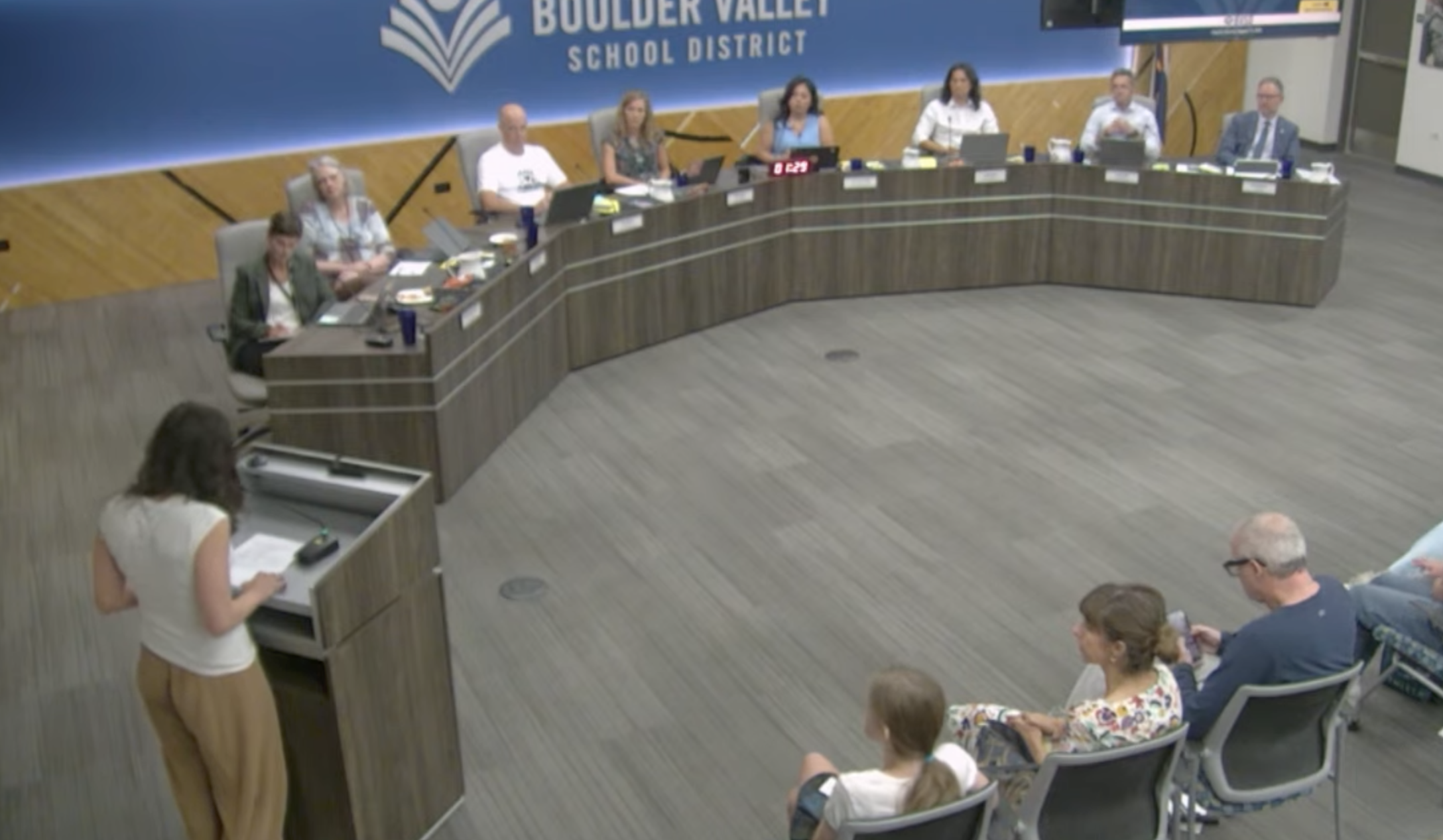
During Tuesday’s meeting, dozens of speakers were united in condemning antisemitism but differed over whether the district should work with the ADL on the policy changes.
Several described antisemitic, anti-Latino, anti-Asian and anti-Black harassment in district schools. Some renewed calls for an independent oversight panel to review bullying reports.
“Develop a deep and tender curiosity about this issue,” Rabbi Charna Rosenholtz, president of the Boulder Council of Rabbis and Cantors, told the board. “Don’t think you understand it. Want to know more and explore your own biases because that will help us free up this issue.”
Lisa Kunkel, a parent of two Flatirons Elementary students, said the district should address antisemitism but should not partner with the ADL. She and other speakers argued that the organization treats criticism of Israel as inherently antisemitic, potentially chilling political speech.
“The antisemitic incidents described in the ADL’s Title VI complaint are of deep concern, and they warrant a district response,” Kunkel said. But, she added, “The ADL is not a neutral civil rights organization.”
Board members responded by pledging reform.
Board Vice President Alex Medler said the district needs both policy changes and measurable ways to determine whether they improve outcomes.
“How will the person who takes my seat after me know that we are in a better place two or six years from now than we are today?” Medler said.
Read more Boulder Market Meals: Fresh tomato pie captures peak summer flavor

Related Posts
Boulder Valley school closure plan in limbo as judge weighs open meetings lawsuit
Boulder Valley school board votes to close four elementary schools amid calls to delay
